

Woodworking doesn’t forgive small errors. A cabinet door that’s a fraction of a degree off, a miter joint that won’t close flush, a shelf that racks under load, these aren’t cosmetic problems. They’re geometry problems, and they almost always trace back to the layout stage, long before a single cut was made.
That’s why the tools you use to measure and mark matter as much as the ones you use to cut. Here’s what separates a reliable square from a frustrating one.
Why Do Woodworkers Need Precision Layout Tools?
Woodworking is a discipline built on geometry. Whether you’re building kitchen cabinets, crafting furniture, laying out deck framing, or cutting trim for a finish installation, every measurement builds on the one before it. Small errors compound. A joint that’s off by half a degree at one end of a cabinet run can cause a visible gap several feet away.
The best woodworking tools serve three core functions: they guide your layout lines before a cut, verify your cuts after they’re made, and help you maintain consistent geometry throughout an assembly. None of that works if the tool itself isn’t accurate. And accuracy in layout tools isn’t just about the number printed on the scale. It’s about how the tool is made, what it’s made from, and whether that accuracy holds up under real working conditions.
What to Look For in Woodworking Squares
Solid construction.
The body tells you everything. Professional-grade squares use solid aluminum that’s strong enough to hold shape under jobsite conditions, light enough to handle all day. A fully anodized finish adds hardness on top. What to avoid: plastic bodies or thin stamped metal that flexes under pressure. A square that bends isn’t a square.
Markings you can actually read
Printed scales fade with use and moisture. Laser-burned and chemical-etched markings stay readable through years of heavy use. Both cut into the metal itself rather than sitting on top of it, so there’s no ink to wear away, plus, easier to read in low light areas. No need to tilt the tool to catch the light or squint.
Built-in angle capability
A square that only checks 90° is useful. One that also covers a full protractor range — miters, bevels, compound angles, roofing pitches — does the heavy lifting for most of what you’ll encounter. The real advantage: you measure once and transfer directly, cutting out the compounding error that comes from reading one tool and re-setting another.
Conversion tables
Built-in rafter pitches and degree-to-pitch conversions sound like a small thing. On jobs with repetitive angle calculations, they save more time than you’d expect.
A Tool Worth Knowing: Kapro’s 449 Protractor Square
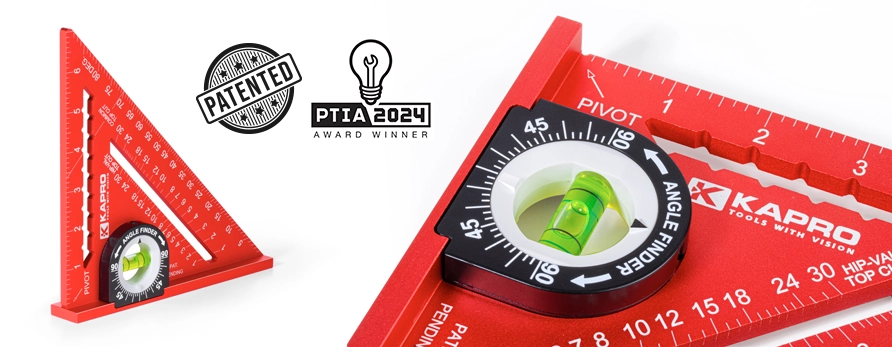
Kapro’s 449 Protractor Square earned both the 2024 Pro Tool Innovation Award and the 2024 HBSDealer Golden Hammer Award – and it’s easy to see why. Its patented design packs square alignment, angle measurement, and layout marking into one fully anodized aluminum body, with laser-etched markings, a dual-sided 0°–90° protractor, molded-in conversion tables, and a flush push-in vial for level verification. For cabinetmakers, finish carpenters, roofers, and stair builders, it replaces several tools with one compact solution.
From cabinetmakers checking square joints to finish carpenters refining miter angles, and roofers or stair builders working with repeated pitch calculations, the 449 replaces multiple tools with one compact, jobsite-ready solution.
Getting the Most Out of It
Check calibration periodically
All tools benefit from a quick verification check. Place the square against a known straight edge, mark a line, flip the tool, and repeat. If the lines align, your square is true. This takes thirty seconds and can prevent an entire session of compounding errors.
Pair it with complementary layout tools
A protractor square works best as part of a broader layout system. Use it alongside a marking gauge, a reliable straightedge, and an accurate measuring tape. For larger projects, full cabinet runs, furniture assemblies, deck layouts, the combination of accurate individual measurements and consistent angle references is what keeps everything true from start to finish.
Store it properly
Layout tools hold their accuracy best when they’re protected from the conditions that cause drift: drops or pressure from other tools. Keep the 449 in a dedicated spot in your kit, not loose at the bottom of a bag.
The Bottom Line
The best woodworking squares aren’t necessarily the most expensive or the most feature-heavy. They’re the ones that deliver accurate, consistent results in the conditions you work in.
If you want to see full specifications and applications of Kapro’s 449 visit the Kapro 449 product page, or view all of Kapro’s line of squares and angles.
